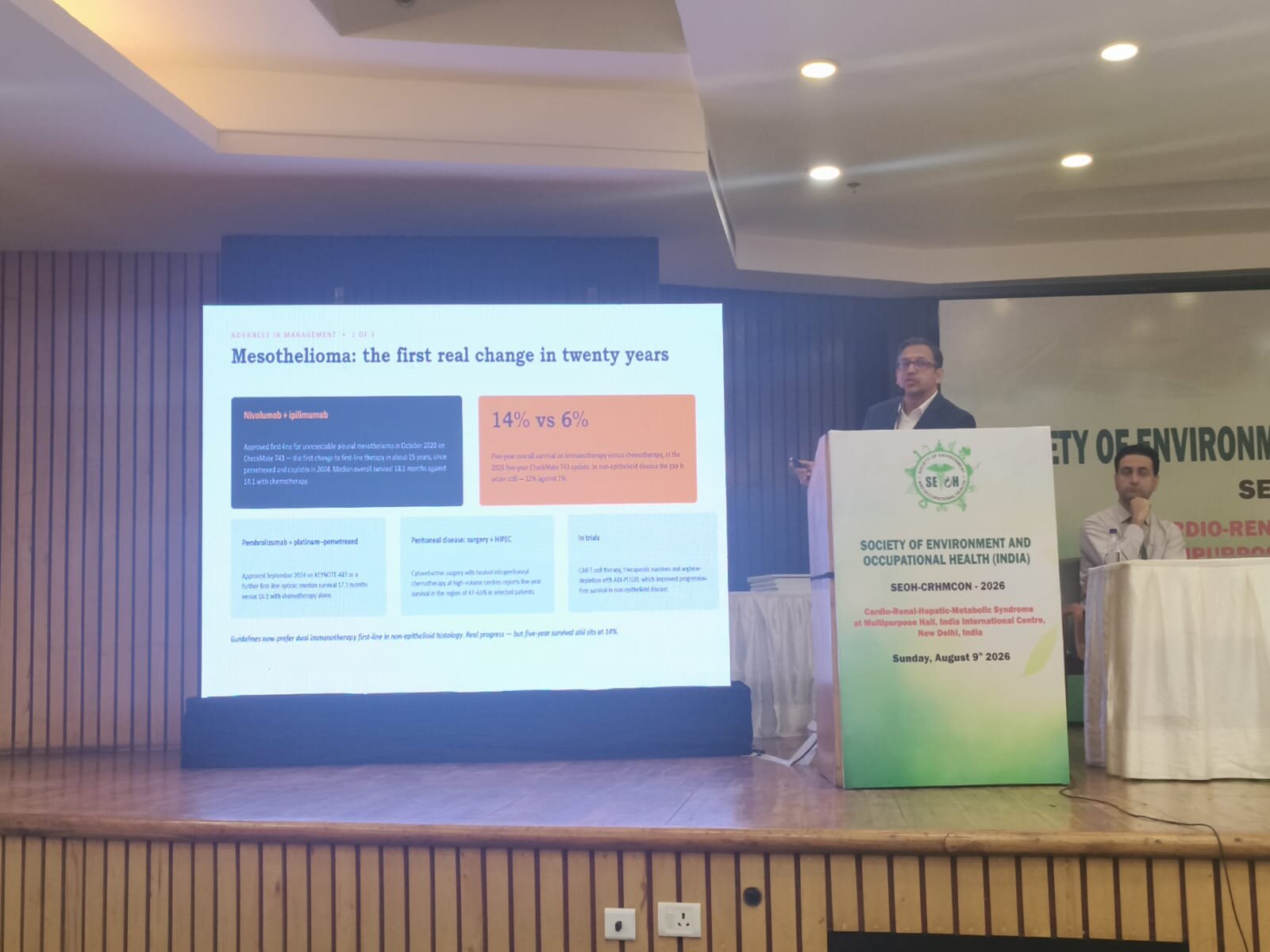
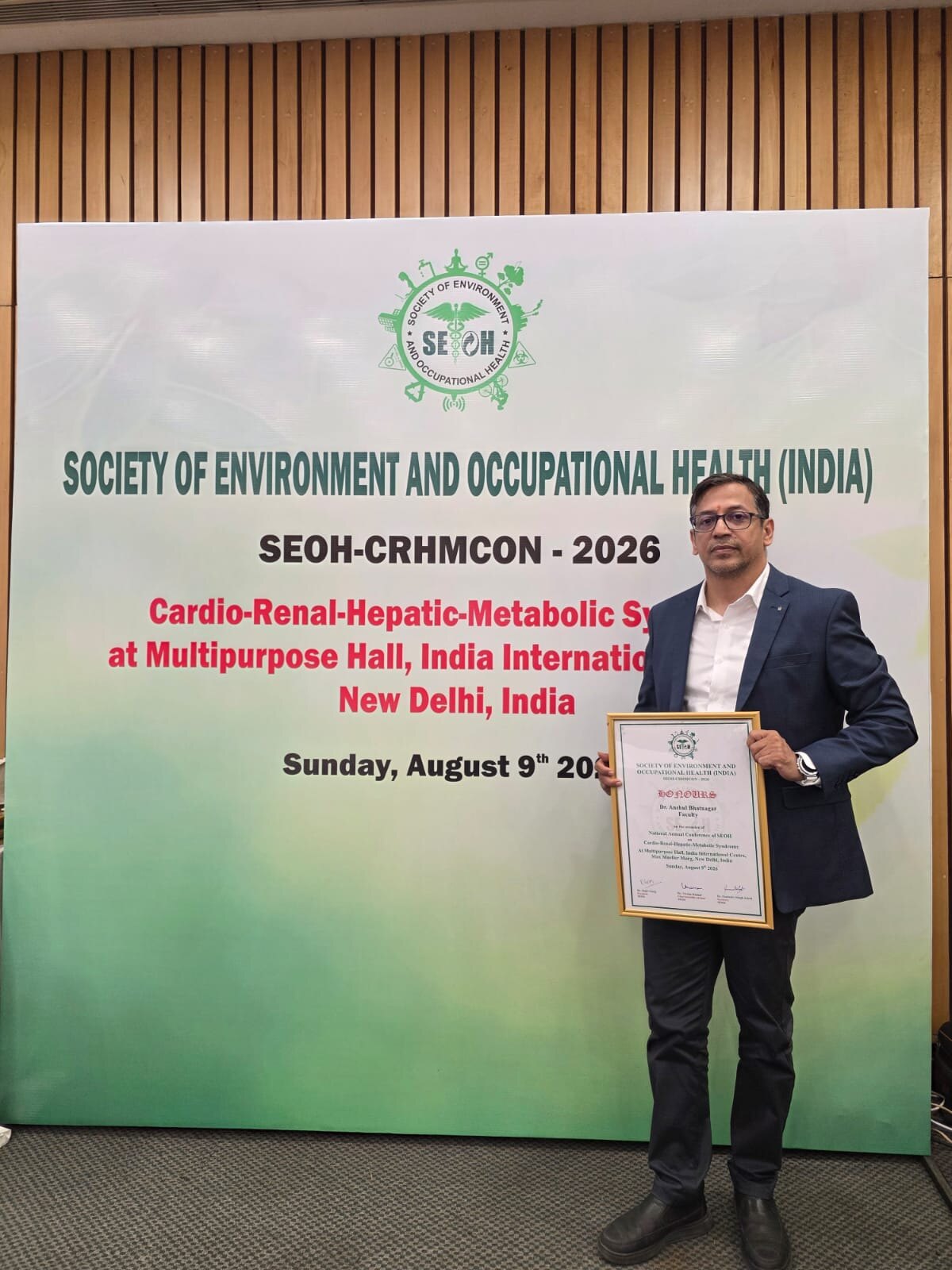
This is the substance of a talk given at the National Annual Conference of the Society of Environment and Occupational Health (India), at the India International Centre, New Delhi. It sets out three carcinogens that travel with construction work, why the disease they cause is so easily missed, and how the treatment of those cancers has genuinely advanced.
India's construction sectorThe workforce at the centre of this
Construction is a high-hazard sector, and the carcinogens travel with the job. Asbestos in roofing, pipes and insulation — cheap and heat-resistant, still in use. Silica dust from cutting, grinding, quarrying and sandblasting stone and concrete. Diesel exhaust from plant and site vehicles running continuously. Asphalt fumes and solvents from road work, waterproofing, coatings and adhesives.
These sit alongside the hazards that do get counted — falls from height, being struck by plant, electrocution. Cancer is the one that does not.
What the numbers do not tell usWe are working almost blind
6,500 deaths at factories, ports, mines and construction sites were reported to Parliament by the Labour Ministry over a five-year period in 2021 — a figure many commentators regard as a serious undercount, partly because of how work fatalities are recorded. Globally, an estimated 2–8% of all cancers arise from carcinogen exposure in occupational settings; India has almost no comparable national data to measure itself against.
Studies on occupational cancer in Indian construction are sparse, and those that exist have tended to examine how workers behave rather than the dangers built into the work itself. Without exposure registers on site, there is nothing to link a cancer diagnosed in 2050 back to a job held in 2020.
The first exposure · AsbestosBanned in 70 countries — India buys the most
Mining was banned in 1993; use was not. Licences stopped being reissued, but import and use continued, with Russia and Brazil the principal suppliers. India's 44% share of world asbestos imports in 2021 was a 29% increase on the year before. This exposure is being created now, not inherited — and construction is the most exposed sector of all, where every worker on a site is at risk, not only those handling the material.
What the fibres do once they are airborne
Airborne asbestos fibres cause lung cancer (the largest absolute contributor), mesothelioma of the pleura, pericardium or peritoneum, and — recognised by the WHO — laryngeal and ovarian cancer. They also cause asbestosis, an untreatable pulmonary fibrosis. Published estimates already put more than 6,000 workers in India affected by asbestosis, with at least a further 600 carrying asbestosis-related lung cancer.
And yet a strip of cloth tied across the face remains a common sight on Indian sites where a certified respirator is required.
LatencyThe bill arrives three decades late
Asbestos-related disease commonly takes three to four decades to manifest — which is precisely why early detection fails. The worker has changed employer, trade and often state before anything shows. Once mesothelioma is diagnosed, typical life expectancy is one to three years. These cancers are incurable, so palliative care is the mainstay — and India's palliative care system is still at an early stage of development. As the authors of the projection put it plainly: we need to examine our ability to meet this coming problem.
The second exposure · SilicaRajasthan's stone belt
Labourers in the unorganised stone quarrying, crushing, cutting and polishing industries carry the highest silica exposure in the country, and the least protection. The disease is irreversible, the employment is informal, and the workforce is increasingly migrant.
- The work — quarrying, crushing, cutting and polishing stone, performed in extreme heat, high noise, poor housing and on low wages.
- The disease — silicosis is irreversible: major loss of lung function and a raised risk of early death from complications such as heart failure. Silica exposure also increases susceptibility to tuberculosis, already common in India.
- The workforce shift — as awareness grew, many local labourers left the industry, replaced by migrants from Bihar, Uttar Pradesh, Madhya Pradesh and West Bengal.
- No safety net — because the employment is informal, these workers cannot access social security benefits.
The third exposure · Solar UVThe exposure nobody is issued protection against
That 1.6 billion is 28% of the entire working-age population of the world, and men account for around 65% of the deaths. Skin cancer has historically been less common in India than in Western countries, and higher melanin levels are protective — but recent data show incidence rising across the country. Outdoor occupations, agriculture and construction above all, mean prolonged sun exposure, and climate change and air pollution are compounding it.
The WHO asks employers and governments to provide shade at the workplace, shift working hours away from the midday UV peak, train and educate outdoor workers, supply sunscreen and protective clothing, and begin protection from a young age — because the damage accumulates over decades.
Where the system fails the workerDiagnosed, and still uncompensated
Four failures compound each other. Causation cannot be proved — establishing a direct link between the job and the cancer, decades later and without exposure records, defeats most claims at the first step. The regulation is not there to cite — safety rules are insufficient to form the basis of a claim. Nobody knows the disease is occupational — awareness is low among the workforce, the wider population, and among clinicians. And the legal system is out of reach, hardest of all for migrant workers with limited access to healthcare and legal help.
Each of these is a documentation problem before it is a legal one — and documentation is something the treating clinician controls.
Advances in management · 1 of 3Mesothelioma: the first real change in twenty years
Nivolumab plus ipilimumab was approved first-line for unresectable pleural mesothelioma in October 2020 on the CheckMate 743 trial — the first change to first-line therapy in about 15 years, since pemetrexed and cisplatin in 2004. Median overall survival was 18.1 months against 14.1 with chemotherapy. On the 2026 five-year CheckMate 743 update, five-year overall survival was 14% versus 6% for chemotherapy — and in non-epithelioid disease the gap is wider still, 12% against 1%.
Since then, pembrolizumab with platinum–pemetrexed was approved in September 2024 (KEYNOTE-483) as a further first-line option, and for peritoneal disease, cytoreductive surgery with heated intraperitoneal chemotherapy (HIPEC) at high-volume centres reports five-year survival in the region of 47–65% in selected patients. CAR T-cell therapy, therapeutic vaccines and arginine-depletion with ADI-PEG20 are in trials. Guidelines now prefer dual immunotherapy first-line in non-epithelioid histology — real progress, though five-year survival still sits at 14%.
Advances in management · 2 of 3Lung cancer: the field has been rebuilt
Low-dose CT screening has moved detection to more curable stages in high-risk groups, and the case for extending it to asbestos- and silica-exposed cohorts is strengthening. In resectable disease, perioperative chemo-immunotherapy is now standard in non-oncogene-driven cancer, with adjuvant osimertinib in EGFR-mutant and alectinib in ALK-rearranged disease. In advanced disease, molecular profiling is mandatory, antibody–drug conjugates are maturing, and circulating tumour DNA is emerging for minimal residual disease detection.
The occupational patient benefits from all of this identically — provided the cancer is found early enough for it to matter. That is a screening and surveillance problem, not a drug problem.
Advances in management · 3 of 3Skin cancer: curable early, treatable late
Surgery remains curative in the large majority; occupational skin cancer is overwhelmingly keratinocyte carcinoma — cutaneous squamous cell and basal cell — on the chronically sun-exposed head, neck and forearms. In advanced disease, cemiplimab (a PD-1 inhibitor) was the first checkpoint agent approved for advanced cutaneous squamous cell carcinoma and is now standard of care. Since October 2025 the FDA has approved adjuvant cemiplimab for high-risk disease after surgery and radiotherapy, on the phase III C-POST trial in 415 patients, and pooled neoadjuvant data report pathological response in around 72% of patients — a route to smaller surgery and less disfigurement on the face and scalp.
PreventionWhat would actually reduce the burden
Government can regulate and enforce control of carcinogen exposure on site, mandate shade, adjusted hours and protective clothing for outdoor work, recognise occupational cancers and simplify the compensation route, and fund surveillance and palliative capacity ahead of the projected wave.
Employers can control exposure at source — substitute, enclose, suppress dust — issue and enforce PPE that meets international standards rather than cloth, deploy health inspectors and routine worker health checks, and keep exposure records that outlive the contract.
Clinicians can take and document an occupational history on every cancer patient, treat mesothelioma and silicosis as sentinel events warranting site enquiry, support claims with written attribution, and build palliative capacity for incurable asbestos disease. Exposure is preventable at almost no cost compared with the disease it produces.
The trajectoryIt gets worse before it gets better
The sector keeps growing, toward roughly 100 million construction workers in the coming decades. Migration keeps rising alongside it, and so does the exposed population — occupational cancer among construction workers is expected to rise correspondingly. The health system must be ready to meet it, which warrants immediate attention from policymakers.